Transporto priemonė į eismą patenka tik gavusi atitinkamą leidimą. Vyraujanti tokio leidimo atvaizdavimo ir atpažinimo viešumoje forma yra registracijos numerio ženklai (plokštelės). Nors išduodami neterminuotai, dauguma jų, atsižvelgiant į reikalavimus, galioja nustatytą laikotarpį, kadangi būtinas periodinis transporto atitikimo šalių įstatymuose numatytoms sąlygoms tikrinimas.
Automobilių žurnalistas Valdas Viliūnas prisimena, jog pirmieji atkurtos nepriklausomos Lietuvos kelių transporto priemonių numeriai buvo labai gražūs ir originalūs. Kiekvieną numerį puošė Lietuvos vėliava, o apskritis turėjo savo vidurinę raidę trijų raidžių kombinacijoje, tad kiekvienas galėjo atskirti, kur buvo priregistruotas automobilis. „Pavyzdžiui, vidurinė raidė „V“ nurodė, kad automobilis buvo priregistruotas Vilniaus apskrityje. Tokių gražių ir pažangių valstybinių numerių neturėjo nė vieni arčiau esantys kaimynai. Ir dabar automobilių valstybiniai numeriai su Lietuvos valstybine vėliavą yra labai vertinami bei branginami“, - portalui LRT.lt kalbėjo V. Vilūnas.
Automobilių žurnalistas prisimena, jog kiek vėliau atsirado specialūs juodi valstybės numeriai kariškių automobiliams. Įstojus į ES, Lietuvos vėliavą valstybiniuose numeriuose pakeitė Europos žvaigždutės. Neseniai pradėti naudoti specialūs rudi valstybės ženklai istoriniams automobiliams su raide „H“. „Tokius numerius gauna pripažintos istorinėmis kelių transporto priemonės. Jie ne tik nurodo, kad automobilis ar motociklas yra senesnis nei 30 metų ir autentiškas, bet su tokiais numeriais yra paprastesnė techninė apžiūra“, - teigė V. Vilūnas.
Ar pamenate laikus, kai parlamentarai turėjo išskirtinę privilegiją transporto priemones padabinti LRS (Lietuvos Respublikos Seimo) numeriais? Bėgant metams tai tapo pasiekiama kiekvienam, nes registracijos numerius su šiomis trimis raidėmis galėjo įsigyti bet kuris pilietis.
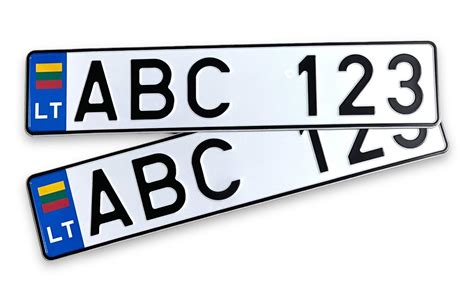
Šeši standartiniai registracijos numerio tipai
Kaip informuoja VĮ „Regitra“, pagal galiojančius teisės aktus yra 6 standartiniai registracijos numerio tipai, taip pat atskiri registracijos numeriai istorinėms motorinėms transporto priemonėms ir galingiesiems keturračiams bei elektromobiliams.
I tipo
- Bendrojo naudojimo automobiliams ženklinti skirtuose numerio ženkluose - trys raidės ir trys skaitmenys;
- priekaboms ir puspriekabėms ženklinti skirtuose numerio ženkluose - dvi raidės ir trys skaitmenys;
- motociklams ženklinti skirtuose numerio ženkluose - trys skaitmenys ir dvi raidės;
- mopedams (motociklams) ženklinti skirtuose 4-ojo formato numerio ženkluose - du skaitmenys ir trys raidės.
Be to, gali būti išduodami ir naudojami numerio ženklai, kurių užrašas sudaromas klientų pageidavimu. Tokį užrašą automobiliams, priekaboms ir puspriekabėms ženklinti skirtuose numerio ženkluose gali sudaryti nuo vieno iki šešių skaitmenų arba skaitmenų ir raidžių, o motociklams ženklinti skirtuose numerio ženkluose - nuo vieno iki penkių skaitmenų arba skaitmenų ir raidžių.
Nuo 2016 m. liepos 1 d. atsirado ekologiškoms transporto priemonėms skirta EV registracijos numerių serija, kurią sudaro dvi raidės EV ir keturi skaitmenys. Iki šiol yra išduoti 69 šios serijos numeriai.
II tipo
Kariškių transporto priemonėms. Nuo 2008 m. spalio 1 d., įsteigus Lietuvos Respublikos taktinės ir logistinės paskirties transporto priemonių registrą, „Regitra“ nevykdo transporto, kurį patikėjimo teise valdo Lietuvos kariuomenė ar jos padaliniai, registracijos procedūrų.
III tipo
Taksi. Numerio ženklo paviršius geltonas, atspindintis šviesą; kairiajame numerio ženklo krašte mėlyna juosta; numerio ženklo apvadas, raidės ir skaitmenys juodi. Numerio ženklo mėlynojoje juostoje yra Europos Sąjungos simbolis ir baltas Lietuvos Respublikos skiriamasis ženklas LT. Numerio ženkle yra įspausti du apskritimo formos apvadėliai, žymintys vietas,
IV tipo
Užsienio valstybių diplomatinių atstovybių, konsulinių įstaigų ir tarptautinių organizacijų atstovybių transporto priemonėms. Numerio ženklo paviršius žalias, atspindintis šviesą; numerio ženklo apvadas, raidės ir skaitmenys balti. Numerio ženkle yra įspausti du apskritimo formos apvadėliai, žymintys vietas, skirtas klijuoti hologramai ir valstybinės techninės apžiūros ženklui. 1-ojo formato plokštelėje apvadėliai įspaudžiami vienas virš kito kairiajame numerio ženklo krašte, o 2-ojo ir 3-ojo formato plokštelėse - vienas šalia kito centrinėje numerio ženklo dalyje po užrašu. Šio tipo numerio ženklų užrašus sudaro šeši skaitmenys, iš kurių pirmieji du skaitmenys žymi atstovybės kodą, kurį suteikia URM Protokolo departamentas pagal atstovybės akreditacijos Lietuvos Respublikoje eiliškumą. Trečias skaitmuo žymi transporto priemonės kategoriją (asmens, kuriam priklauso transporto priemonė, statusą). Paskutinieji trys skaitmenys žymi numerio ženklų išdavimo eilės numerį.
V tipo
Įvežamoms į Lietuvos Respubliką arba išvežamoms iš jos (neįregistruotoms) transporto priemonėms. Numerio ženklo paviršius baltas, atspindintis šviesą, su pasikartojančiu saugos ženklu; numerio ženklo apvadas, raidės ir skaitmenys raudoni. Kairiajame numerio ženklo krašte mėlyna juosta. Numerio ženklo mėlynojoje juostoje yra Europos Sąjungos simbolis ir baltas Lietuvos Respublikos skiriamasis ženklas LT. Užrašą automobiliams žymėti skirtuose numerio ženkluose sudaro penki skaitmenys ir dvi raidės.
VI tipo
Transporto priemonėmis prekiaujančių įmonių ar organizacijų parduodamoms (neįregistruotoms) transporto priemonėms. Numerio ženklo paviršius baltas, atspindintis šviesą, su pasikartojančiu saugos ženklu; kairiajame numerio ženklo krašte mėlyna juosta; numerio ženklo apvadas, raidės ir skaitmenys raudoni. Numerio ženklo mėlynojoje juostoje yra Europos Sąjungos simbolis ir baltas Lietuvos Respublikos skiriamasis ženklas LT. Šio tipo numerio ženklų užrašus sudaro „P" arba „R" raidė ir: automobiliams žymėti skirtuose numerio ženkluose - šeši skaitmenys; priekaboms ir puspriekabėms žymėti skirtuose numerio ženkluose - penki skaitmenys; motociklams žymėti skirtuose numerio ženkluose - keturi skaitmenys. Paskutinieji du užraše esantys skaitmenys, atitinka numerio ženklo galiojimo metų paskutiniuosius du skaitmenis.
Istoriniai numeriai
Numerio ženklo paviršius rudas, atspindintis šviesą, su pasikartojančiu saugos ženklu; kairiajame numerio ženklo krašte mėlyna juosta; numerio ženklo apvadas, raidės ir skaitmenys balti. Numerio ženklo mėlynojoje juostoje yra Europos Sąjungos simbolis ir baltas Lietuvos Respublikos skiriamasis ženklas LT. Numerio ženkle yra įspausti du apskritimo formos apvadėliai, žymintys vietas hologramai ir privalomosios techninės apžiūros ženklui. Valstybinį registracijos numerį sudaro: automobiliams ženklinti skirtuose numerio ženkluose - raidė „H", du skaitmenys, nurodantys transporto priemonės gamybos metus, ir trys skaitmenys, nurodantys eilės numerį (nuo 001 iki 999 eilės didėjimo tvarka); motociklams ženklinti skirtuose numerio ženkluose - trys skaitmenys, nurodantys eilės numerį (nuo 001 iki 999 eilės didėjimo tvarka), ir du skaitmenys, nurodantys transporto priemonės gamybos metus.
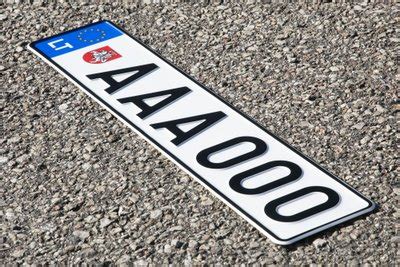
Lentelė su registracijos numeriu
VĮ „Regitra“ priima prašymus išduoti lentelę su registracijos numeriu. Prašymą galima pateikti transporto priemonių registravimo paslaugas teikiančiame padalinyje arba e. paslaugų portale. Lentelė skirta ženklinti motorines transporto priemones tais atvejais, kai vežamas prie transporto priemonės ir (ar) priekabos galinės dalies pritvirtintas vienas ar keli dviračiai uždengia valstybinio numerio ženklą. Lentelėje įspaustas transporto priemonės valstybinis numeris ir juodos spalvos dviračio atvaizdas.
Valstybinių registracijos numerio ženklų išdavimo dinamika 2013-2015 m.
VĮ „Regitra“ administruojamo Kelių transporto priemonių registro duomenys:
| Metai | Išduota plokštelių | I tipo | III tipo | IV tipo | V tipo | VI tipo | Istoriniai | Galingųjų keturračių | Lentelių su valstybiniu numeriu |
|---|---|---|---|---|---|---|---|---|---|
| 2013 | 389 346 | 177 916 | 1 243 | 119 | 63 119 | 15 395 | 0 | 297 | 0 |
| 2014 | 374 079 | 164 219 | 1 008 | 112 | 62 659 | 18 687 | 113 | 0 | 5 800 |
| 2015 | 369 247 | 176 027 | 1 308 | 107 | 75 494 | 5 601 | 180 | 0 | 3 400 |
The Land Rover Range Rover (L322), generally shortened to Range Rover, is the third-generation Range Rover from British carmaker Land Rover, produced from 2001 through 2012. Contrary to its forebears, it is the first Range Rover with a unitary body structure, and it switched to all around independent suspension instead of front and rear rigid, live axles. The L322 was originally planned and developed as the 'L30', under BMW ownership. The vehicle was intended to share components and systems (electronics, core power units etc.) with the BMW 7 Series (E38). In the UK and many other territories, ascending trim levels were initially marketed as "SE", "HSE" and "Vogue". The previous generation P38 Range Rover (or "Pegasus") had been developed whilst the Rover Group was owned by British Aerospace, and budgetary constraints during the development had been extremely tight. There was also press criticism of the P38A that its styling lacked the "presence" of the original 1970 Range Rover. When the Rover Group was taken over by BMW shortly after the P38A's launch in 1994, the newly installed BMW management at Land Rover quickly concluded that the car would not have a long shelf life compared to its predecessor, due to its fundamentally dated underpinnings, and cancelled the planned '99 Model Year' updates. The L30 project was a joint one involving engineers from both Rover Group and BMW and was initially based at BMW's FIZ Engineering Centre in Munich before transferring to Land Rover's Solihull plant for the final stages prior to volume production. The third-generation Range Rover was designed to accommodate BMW's M62 V8 engines for future models. The manual transmission was dropped entirely, leaving only the automatic transmission. The BMW 7 Series E38 electronics system were being phased out during the development of the third-generation Range Rover, and being replaced with the electronics from the BMW E39 5 Series. The entertainment system (Radio Function, Navigation System, Television and Telecommunications systems, as well as the automotive computer bus system) on pre-facelift models were almost identical to those in the BMW E39 5 Series. The design has a monocoque (unibody) construction with four-wheel independent air suspension. Air suspension allowed variable ride height and achieved similar axle articulation to the previous live axle design. Early US-specification Range Rover included air conditioning with tri-zone climate controls with interior air filter, power tilt/telescopic leather-wrapped steering wheel with radio controls, cruise control, memory system, leather upholstered twelve-way power driver seats, ten-way power passenger seat, power sunroof, a premium sound system with six-disc CD changer, navigation system with voice activation, rearview camera, wireless mobile phone link, universal garage door opener, and outside-temperature indicator.
The Range Rover's exterior was updated in 2005 for the model year 2006 along with the BMW V8 being replaced with a Jaguar unit (some cars registered in 2005 have the new Jaguar engines). The new engine choices were Jaguar's AJ-V8, with 4.4-litre 300 hp (220 kW) or 4.2-litre 400 hp (300 kW) supercharged variants. The engines are aluminium alloy units, with advanced torque-based engine management system, drive-by-wire throttle control, and variable camshaft phasing (on the 4.4-litre version). In addition to the engine change, the 2006 Range Rover is equipped with an updated "infotainment" system. This includes a touch screen with on and off-road navigation, radio, CD, Satellite Radio (US), telephone, rear view camera, a wireless video camera system and other additional features all accessed via the same user interface. The audio system is Harman Kardon Logic 7 surround sound. This system is linked by an industry-standard fibre optic network known as Media Oriented Systems Transport or MOST and an electronic network system known as CAN bus. Suppliers for the 2006 Range Rover's components include Continental Automotive for the complete cockpit module which incorporates the Denso touch screen navigation unit. Continental also supply the centre console unit. Other suppliers include Alpine car audio for integrated head unit rear seat entertainment. Most importantly the audio system was co-developed with Harman Kardon. For 2007, many of the Range Rover's changes were mechanical or interior. On the inside, the hidden folding cup holder that popped out of the end of the dashboard in previous models was replaced by a simpler and more durable in-console design with sliding covers (similar in concept, but higher quality, to those in the Range Rover Sport). The handbrake is now electronic. Additionally, the seats differ from the old style, resembling the new Range Rover Sports seat design. Heated seats are standard across the board, with newly available climate controlled front seats standard on all supercharged trims and HSE Luxury/Vogue, with three settings for cool air and hot air activated by round dials on either side of the analog clock on the lower part of the center control stack, and the premium leather seats from the BMW era are no longer available, with new more premium quality leather in different grains for HSE/Vogue, SE/Vogue, HSE Luxury/ Vogue and all supercharged trims. The HVAC system was also updated with more vents (in particular, one placed in the centre of the top dash roll, to improve high-level cold air ventilation, positioned behind the centre speaker) and quieter operation. That, along with the acoustic laminated/heated windscreen lowers noise. An increase in interior storage is mainly attributed to the new split-dual glovebox, although the small upper glovebox is almost entirely occupied by the CD multi-changer and the Venture-cam, if fitted. In a return to original Range Rover styling, more wood inserts have been added to the doors and centre console. Midway through production of the 2007 model (around production date of January 2007) the style of the key was changed from the BMW design to Land Rover's "switchblade" type. This was a sealed unit and contained a rechargeable battery, charged from an exciting coil in the ignition switch, the idea being to avoid the need to replace key batteries for the life of the vehicle. The key contained three buttons: the standard “lock”, “unlock”, and a third “Land Rover” oval button which could be re-programmed to activate a number of functions. This button normally came pre-programmed to operate the tailgate release function. The BMW M57 diesel engine was replaced for 2007 with the TDV8 engine developed by Ford and Land Rover at Dagenham and Gaydon. The 3.6-litre AJD-V8 32-valve twin turbo V8 engine develops 272 hp (203 kW), far more than the 177 hp (132 kW) of the previous engine and so is better capable to deal with the weighty vehicle. The maximum speed is 124 mph, whilst 0-60 mph was reduced to 8.6 seconds, which was good for a car with a kerb weight of 2.75 tons. Other changes for 2007 include better brakes supplied by Brembo, revised suspension, a slightly altered rear carpet shape around the front seat rear mountings, and Land Rover's Terrain Response system.
For the 2010 model year refresh, the Range Rover received an updated exterior grille, a multicamera vision system, front bumper with newly repositioned fog lights lower in the bumper, LED accented bi-xenon headlights/LED tail/brake lights with front and rear amber LED turn signals with a three bar design, optional blind spot assist and adaptive auto high beam headlights which are now part of the new for 2010 vision assist package optional on the HSE and HSE with the luxury package, standard on all supercharged trims. Two new petrol engines (5.0 naturally aspirated V8 and 5.0 supercharged V8), and new features. The interior of the Range Rover was given a minor facelift, consisting mainly of redesigned and repositioned switchgear (which saw many of the originally BMW era designed items updated or replaced), along with new options never before available for Range Rover like the addition of push button engine start/stop. The 2010 Range Rover also gained new visual display units as also seen in the new for 2010 Jaguar XJ (X351). This change consisted of a 12-inch TFT LCD virtual instrument panel, which replaces the conventional cluster design - instead 'virtual' gauges are displayed where physical analog gauges were previously. This allows various sets of information to be displayed as required - for example navigation and map information can be displayed instead of engine readouts, whilst when one of the off-road driving modes is selected on the Terrain Response system the 'gauges' are reorganised to provide space to display the schematic of the vehicle's suspension, steering and transmission systems. The other display unit is fitted to the centre console and uses a bi-directional screen to show different images depending on viewing angle (not available in the US). This allows navigational information to be displayed to the driver, whilst someone in the front passenger seat can use the same screen to use the onboard DVD player at the same time, for example. Unveiled in early 2010, the Holland & Holland edition Range Rover is billed as an all season luxury supercar. It is not an official Land Rover limited edition, the model is produced by Overfinch using a standard Range Rover furnished with unique features using Holland & Holland as design consultants. Supplied to Overfinch unfurnished and sometimes unpainted, when complete they can be maintained officially through any Land Rover dealership. The cars can be finished in five unique colours including Tintern Green, a famous Holland & Holland colour; the cars can also be specified with two-tone leather and extended walnut trim, which can be colour matched to a customer's gun. Features unique to the Holland & Holland include a bespoke rear console and refrigerator including power outputs and storage for branded crystal tumblers. In the boot, all Holland & Holland cars have a gun box fully furnished and including a drinks cabinet.
The 2011 model year Range Rovers include minor styling changes, improved interiors and an upgraded 4x4 system as well new optional packages. A new 4.4-litre TDV8 diesel engine became available with a new ZF 8HP70 eight-speed automatic transmission. By the time of the launch, Land Rover had been sold to Ford in 2000, as part of the splitting up of the Rover Group. To celebrate twenty years in North America, Land Rover produced the 20th Anniversary Edition Range Rover, of which only forty were produced. Each vehicle is a supercharged Range Rover in a special pearl white paint with "Diamond" split-spoke 20-inch wheels and a unique, two-tone interior. Badges on the tailgate and door sills denote the vehicle as such and lists its production number out of the 40. Only one of each model was distributed per dealer, and the dealerships were chosen in a lottery. This was a UK spec production run. To celebrate thirty years, Land Rover produced the 35th Anniversary Edition Range Rover, of which only thirty were produced. Each vehicle of this edition were finished in Claret coachwork with 2-tone claret/jet interiors. To celebrate forty years, Land Rover produced the 40th Anniversary Edition Range Rover. Autobiography Black model features a different grille, Barolo Black paintwork, and a choice of Jet/Ivory or Jet/Pimento interiors. A special edition produced wholly by Land Rover. In the front, the car is little different from a standard Autobiography, more wood finishes are offered, as are a few unique trim pieces. The difference is in the rear cabin, which is furnished with two iPads, a fixed armrest with metal laptop desk, electric reclining climate-controlled seats, and a refrigerator. The car can be ordered in two colours, with 20-inch wheels, body-coloured door handles and smoked grills and gills. An armoured Range Rover Vogue was developed by Land Rover Special Vehicles in 2007, in cooperation with Armour Holdings Group. The vehicle was certified for European B6 ballistic protection standard. It includes side-blast and under-floor grenade protection, uprated suspension, handling and braking system, wheels fitted with run-flat tire system, and fuel cut-off override.
tags: #range #rover #l322 #valstybiniai #numeriai